Anyone who’s been through the mental rigors of a full-blown home renovation, or even a very involved DIY home-improvement project, is familiar with the blizzard of decisions that accompanies such an endeavor. Building a new deck is a good example of this experience. The first decision points are likely to be style, color, material, size, i.e., the fun stuff. But deck railing height? Not so much, probably, but you’ll have to think about it at some point.
That’s because deck railing height is a safety and code issue. Your deck will need to pass inspection and, more importantly, protect the people who use it. Maryland follows the International Residential Code (IRC), and individual counties and municipalities can layer their own amendments on top of it. That combination is where a lot of homeowners, and even contractors, get tripped up. It’s good to know the required heights, the spacing rules for balusters, and exactly when a railing is legally required in the first place.
When Is a Deck Railing Required?
A deck railing, or guardrail, is required once a deck surface sits more than 30 inches above the grade below it. In short:
- Under 30 inches above grade: A railing is optional.
- At or above 30 inches: A guardrail is mandatory.
The reason is simple. The 30-inch mark is roughly the point where a fall is likely to cause serious injury, and the higher the deck, the greater the risk. So the code draws a firm line to reduce fall hazards. If any part of your deck platform crosses that threshold, plan on a guardrail.
How High Should a Deck Railing Be? (Height Requirements)
So how high should a deck railing be? For most homes, the answer is at least 36 inches, measured from the deck surface to the top of the rail. The height depends on the type of project:
- Residential decks: A minimum of 36 inches under the IRC
- Commercial and many multi-family decks: A taller 42-inch guardrail
If you’re building a standard backyard deck, 36 inches is your number, but always confirm your project’s category. Getting deck railing height right the first time saves you from tearing out and rebuilding a rail that misses the mark.
Deck Baluster & Baluster Spacing Requirements
Balusters are the vertical pieces that fill the space between posts, and their spacing is strictly regulated. The rules come down to a simple sphere test:
- Gaps between balusters must be narrow enough that a four-inch sphere can’t pass through.
- The same four-inch principle applies to the gap below the bottom rail.
- On stairs, a six-inch sphere is allowed to pass through the triangular opening formed where the tread, riser, and bottom rail meet.
The goal is to keep small children from slipping through or getting stuck. Proper baluster spacing is just as important to passing inspection as your deck railing height.
Stair & Handrail Requirements
Stairs bring their own set of rules:
- A graspable handrail is required on any stairway with four or more risers.
- Handrail height should typically fall between 34 and 38 inches, measured from the stair nosing.
It also helps to know the difference between the two railing types, since people often use the terms interchangeably:
- Guardrail: Protects against falling off the edge of a raised surface
- Handrail: Gives you something to grip as you climb or descend stairs
A full deck stair system often needs both.
How Maryland & Local Jurisdictions Apply the Code
Maryland adopts the IRC statewide, so the deck railing code baseline is consistent from county to county. That said, local jurisdictions can and do amend the code, adding their own requirements on top of the state standard. This is why you should always confirm the specifics with your local permitting office before you build. Pulling a permit isn’t just paperwork: It’s your assurance that the deck railing code being applied to your project matches what the inspector will check. In Frederick County and surrounding jurisdictions, a quick call to the local office will tell you what applies to your address.
Choosing a Railing That Meets Code
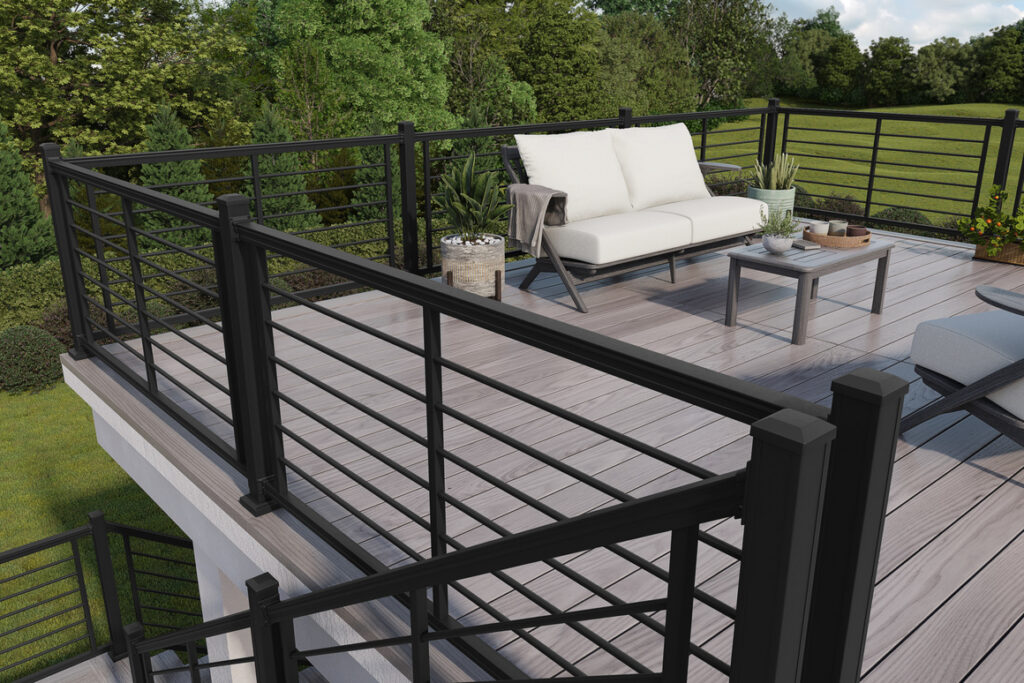
Once you know the rules, the easy path is to choose a railing system engineered to meet them. Code-compliant railing systems take the guesswork out of height and spacing, because the components are already sized to satisfy the standard deck railing height and baluster gaps. Key-Link is one such option: their aluminum railing systems are built for code compliance and long-term durability.
At Ladiesburg Lumber & Supply, we carry a range of materials to fit any project:
- Vinyl
- Aluminum, including Key-Link
- Composite
- Cable
- Wood
Get Code-Compliant Railings at Ladiesburg Lumber
Still unsure about your deck railing height or which system fits your build? Stop by Ladiesburg Lumber in Keymar, MD. Our knowledgeable team can match a compliant railing system to your project, walk you through trusted vendors like Key-Link, and answer your code questions in person. Request a quote today and build with confidence.